Dear Young People: Politics Didn’t Always Feel Like This
On Polarization, Party Labels, and the Rise of the Independent Voter
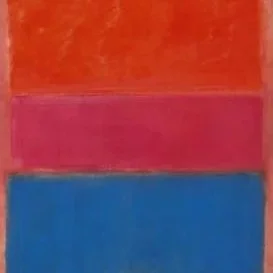
Rothko, No 1 (Royal Red and Blue)
It might surprise young people to learn that politics didn’t always feel like… this.
When I was in high school from 2005-2009, the world didn’t feel especially political. Yes, there was a war. Yes, I teared up when Obama was inaugurated to the soaring sound of City of Blinding Lights by U2. Yes, political stuff happened. But politics were also something you could avoid. This likely had a lot to do with the fact that we had flip phones which required you to press the 7 key four times to produce the letter S.
Back in those days, I identified as a liberal without pause.
It wasn’t a loaded thing to be. Instead, it was a nice label that aligned with my values of intelligence, empathy, and helping people live their fullest potential. As a teen, I advocated for RED’s fight against HIV/AIDS, convinced my parents to let me sleep in a field overnight to raise awareness for the Lost Boys of Sudan, and participated in other heartening activities with likeminded kids.
It was an easy and joyous time to be a person who simply cared about other people.
When I graduated high school in 2009, I moved to Washington DC. And even there — living just four blocks away from the White House, with motorcades regularly blocking my walk to class — things still didn’t feel especially political. Sure, you’d go to happy hours where Hill interns flashed their badges. Yes, there were poli sci students who thought of themselves as West Wing characters. And occasionally, you’d find a drunk congressman at a house party.
But beyond rushing the gates of the White House when Obama was reelected, I don’t remember being asked about my politics.
Even in moments of political upheaval (think: Tea Party and Occupy Wall Street movements circa 2009-2011), it didn’t feel quite as personal, as pervasive, as loud. All of this is to say: the fight-to-the-death partisanship we experience today is relatively new, or at least not something the country has seen since the Civil War.
Across twelve countries, the US has experienced the largest increase in affective political polarization (how negatively we feel toward political parties other than own) over the past four decades.1 And this polarization is personal: In 2022, 72% of Republicans and 63% of Democrats viewed the other as more immoral than other Americans, up from 47% and 35% in 2016 (other accusations include dishonest, lazy, unintelligent, and close-minded).2 Scholars attribute this hostility to the effects of social media, virtual echo chambers, and 24-hour partisan media.
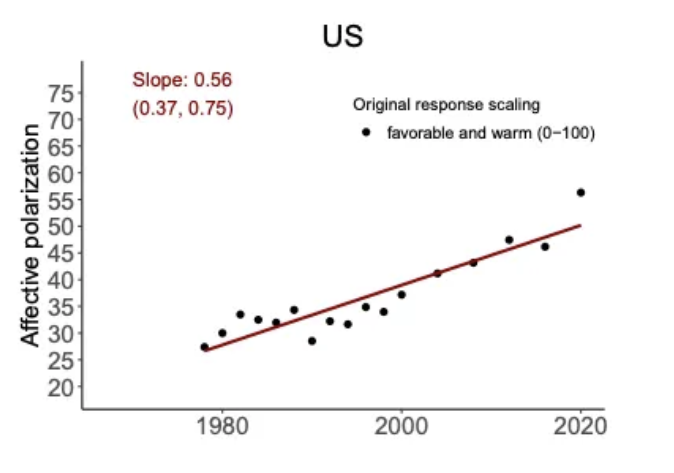
Of course, this polarization is also fueled by our, errr, leadership.
The US is now the only country in which leader affective polarization (intense emotional dislike of opposing political leaders) is significantly higher than polarization toward political parties themselves.3 Trump has been ranked by experts as the most polarizing president in U.S. history, though even this fact is polarizing: There is less disagreement among Democrat experts about the rating of Trump than there is among Republican experts.4
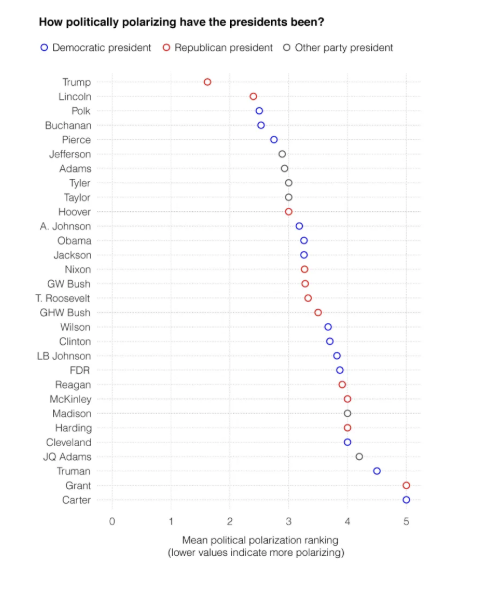
This generally matches my own memory lane.
Purely from a vibes perspective, the scales felt like they began tipping around 2017, right around the Trump presidency, launch of TikTok, and what felt like a rapid escalation in the use of smartphones. By 2020, with the COVID-19 pandemic, George Floyd killing, and Trump’s daily antics — fueled by the fact that we were necessarily glued to our phones, TVs, and computers — the polarization roiled over.
But here’s some potentially good news…
According to a new Gallup poll, the number of Americans identifying as independents has reached a record high, with 45% saying they do not identify with either political party.5 This ship jumping is particularly common among the young and is attributed to a growing disdain for both the Democrat and Republication parties.
Indeed, many (myself included) find party labels increasingly claustrophobic.
Across the political spectrum, we are witnessing the red flags that philosophers since time immemorial have warned about: Blanket statements. Us versus them thinking. Moral righteousness. False binaries. Intellectual oversimplification. Gaslighting. Public shaming. Purity tests. Dehumanization. Certainty without proof. Categorical determinations of evilness over what should be mere disagreement.
Suddenly, it no longer feels like an easy and joyous time to be a person who simply cares about other people.
Any action or statement, no matter how well-intended, has the potential to become a moral hot potato. I think back to my early, innocent days of activism with wistful fondness: No one interrogated me on why I was supporting this country and not that country. No one came at me not seeming sad enough in the pictures. No one felt the need to oust my causes of choice as wrong or misinformed.
There was just a sense of respect that I was trying my best to be a good person.
Today, belonging to a political party no longer feels wholesome or unifying, but like an exercise in who can throw said flaming potato fastest. In fact, the whole psychosocial value of party affiliation — like identity, belonging, and shared purpose — appears to be eroding. It can perhaps be argued that the costs of party membership now outweigh its benefits, which may explain the move toward independence.
In general, I see this shift as a win for nuance, critical thought, and empathy.
Perhaps I am biased (I have been a registered independent for the past many years), but I believe that assessing issues on a case-by-case basis reflects a pretty rational, reasonable, and moral approach to life. Being independent does not preclude one from supporting ideas, movements, or values other either party, but instead offers customization. The idea that we can copy-and-paste a set of values and ideologies from a template is just too simplistic for a world as complex as ours.
I hope this brings us closer to a world in which caring about people isn’t political.
In softening our stance on “sides,” maybe we can get closer to those younger, feel-good days when we were genuinely on each other’s. Maybe without the labels, the extremes, the othering, we can get back to doing good in a way that feels good to us, without it needing to be bad for “the other guy.”
1 Boxell, L., Gentzkow, M., & Shapiro, J. M. (2024). Cross-country trends in affective polarization. Review of Economics and Statistics, 106(2), 557-565.
2 Pew Research Center (2022), “Republicans and Democrats increasingly critical of people in the opposing party”, Pew Research Center, August 9, 2022.
3 Garzia, D., Ferreira da Silva, F., & Maye, S. (2023). Affective polarization in comparative and longitudinal perspective. Public Opinion Quarterly, 87(1), 219-231.
4 Eady, G., Rottinghaus, B., & Vaughn, J. S. (2018, March 20). Comparing Trump to the greatest—and the most polarizing—presidents in US history. Brookings Institution.
5 Gallup. (2026, January 12). New high of 45% in U.S. identify as political independents. Gallup. https://news.gallup.com/poll/700499/new-high-identify-political-independents.aspx